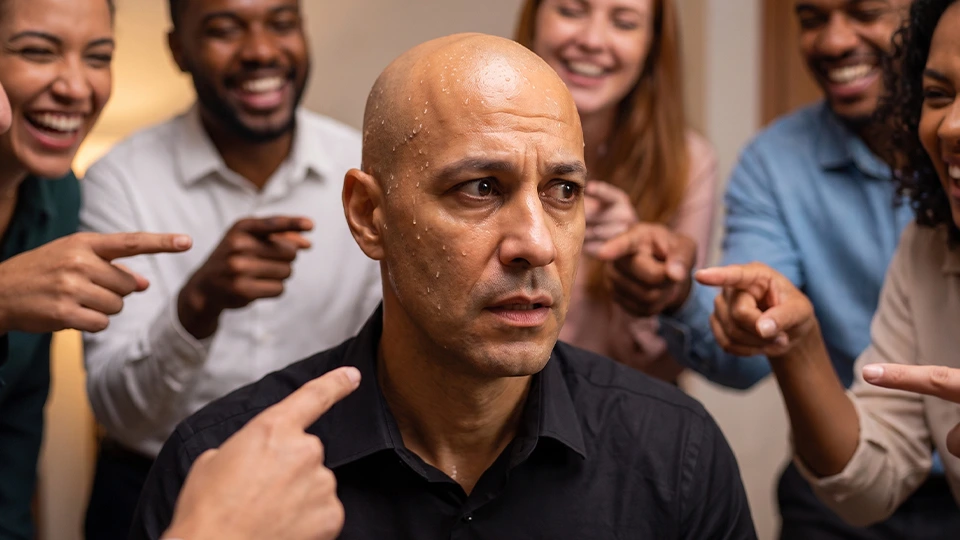
Speaking in front of other people brings two powerful human experiences into the same room: the desire to be understood and the fear of being judged. That is why a presentation lasting only a few minutes can trigger such an intense reaction. Your voice changes, your palms become damp, your heart races, and one question takes up the space that used to belong to your ideas: “What are they thinking about me?”
We often call this embarrassment, but several different experiences may be involved. There is the natural nervousness of doing something important, the fear of making a visible mistake, performance anxiety, and, in some cases, broader distress related to social anxiety. Understanding the difference matters because the answer is not to order your body to “calm down” or wait for confidence to appear before you act.
Fear of public speaking begins to lose its grip when it is no longer treated as evidence of incompetence. Most of the time, it is an overactive attempt at protection: the mind predicts rejection, the body prepares for danger, and attention locks onto every possible sign of failure. The problem is not that the alarm goes off. The problem is treating everything it says as a command.
What You Will Find in This Article
- The social stage: why being seen can feel so risky
- Your body is not exposing you
- When attention becomes a mirror
- The protections that keep fear alive
- Overcoming fear does not mean eliminating nerves
- An exposure ladder, not a leap into the dark
- How to practice in a way that teaches you something
- Preparation that creates freedom
- The audience is not one mind
- After the speech: beware of the private courtroom
- When to seek professional support
- Courage is not the absence of exposure
Audio version of this article
The social stage: why being seen can feel so risky
Imagine that you are about to give a presentation. Before you begin, your mind is not assessing the material alone. It is also trying to calculate your standing in the group. “What if I forget?” “What if my voice shakes?” “What if they ask something I cannot answer?” Beneath these questions is a central fear: that one temporary mistake will reveal something negative about who you are.
This is one reason public speaking can feel harder than completing an equally complex task alone. You are not just organizing information. It can also seem necessary to manage your image while other people watch. A presentation stops being a simple act of communication and becomes, internally, a trial.
The U.S. National Institute of Mental Health lists public speaking among the situations that can provoke anxiety when a person fears being watched, evaluated, or judged. For some people, this fear appears mainly in performance situations. For others, it extends to conversations, dates, interviews, eating in public, and many everyday interactions.
That does not mean every uncomfortable moment in front of an audience is a disorder. Nervousness may be expected when the situation is new, important, or unfamiliar. The distinction becomes clearer when the fear is persistent, disproportionate, difficult to control, and begins to restrict education, work, relationships, or meaningful opportunities.
Your body is not exposing you
Just before you speak, your body may shift into a heightened state of alert. Breathing becomes shallower, muscles tense, your mouth feels dry, and memories seem harder to reach. These sensations are uncomfortable, but they do not mean you have lost the ability to communicate. They show that your body has identified an important situation and is mobilizing energy to deal with it.
Distress grows when that activation is interpreted as a visible catastrophe. A racing heart becomes “everyone will see that I am losing control.” A brief pause becomes “I am humiliating myself.” A forgotten word becomes “I know nothing.” The original fear then acquires a second layer: fear that the fear itself will show.
There is a useful finding here. In a study involving a speech task, participants with higher social anxiety rated their performance more negatively than observers did. The physiological measures recorded during the speech also did not neatly match the anxiety the participants reported. In other words, feeling extremely anxious does not automatically mean that the audience witnessed a disaster.
What happens inside you often feels much larger than what anyone can see. You hear every change in your voice, feel every heartbeat, and know every sentence you intended to deliver. The audience receives only part of that experience. They do not have access to the ideal script in your head, so they are not comparing every real sentence with the perfect version you imagined.
When attention becomes a mirror
When people speak while afraid, their attention often splits in two. One part tries to explain the subject. The other monitors posture, facial expression, hands, tone of voice, and every reaction in the room. It is like trying to drive while looking at the rearview mirror more than the road.
This intense self-monitoring does not provide the control it promises. It consumes working memory, magnifies bodily sensations, and weakens contact with both the message and the audience. The mind starts building an internal image of how you must look, then treats that image as though it were the audience’s actual view.
Research on social anxiety helps explain this cycle. In an experiment conducted by researchers from Oxford and King’s College London, adolescents who focused on themselves and used safety behaviors felt and appeared more anxious, and their performance suffered. Because the study involved young people, it should not be carelessly generalized to everyone. Still, it illustrates a mechanism found in cognitive models of social anxiety.
Redirecting attention does not mean ignoring your body. It means changing the assignment. Instead of repeatedly asking, “How do I look?” you ask, “What idea needs to be clear right now?” Attention moves away from the mirror and returns to the conversation.
The protections that keep fear alive
People who fear public speaking often develop strategies intended to prevent any mistake: memorizing every sentence, reading slides without looking up, rushing to finish, hiding their hands, avoiding pauses, refusing questions, or escaping every opportunity to present.
These strategies make sense. They were created to protect you. The problem is the conclusion that remains afterward: “I managed only because I did not look at anyone,” “I avoided humiliation because I read everything,” or “I was safe because I said as little as possible.” The experience does not teach you that you can handle the situation. It teaches you that danger was narrowly avoided.
This helps explain why immediate relief can become expensive. Avoiding one presentation reduces anxiety that day, but it prevents the brain from updating its prediction. It never discovers that you can recover from losing your train of thought, that a pause does not destroy credibility, or that most audience reactions are less hostile than anticipated.
Not all preparation is a safety behavior. Rehearsing, organizing an outline, and knowing the material are legitimate tools. The difference lies in their purpose. Healthy preparation supports communication. Rigid protection tries to guarantee that no uncertainty, discomfort, or imperfection will appear. One supports the speech; the other turns every deviation into a threat.
Overcoming fear does not mean eliminating nerves
There is a trap in the sentence, “I will speak when I feel confident.” Confidence is often imagined as a prerequisite, when it is frequently a result. It grows after you move through manageable experiences, observe what actually happened, and discover that you can act despite discomfort.
Overcoming embarrassment does not mean your heart will never race again. It means no longer interpreting that racing heart as an order to escape. A more useful goal is not to appear perfectly calm but to remain present enough to communicate an idea.
The shift sounds small, but it changes the practice. “I must control my anxiety” puts you at war with your body. “I can make room for anxiety while I speak” reduces the internal struggle. The energy once spent hiding symptoms can return to the message.
An exposure ladder, not a leap into the dark
Gradual exposure is one strategy used in cognitive behavioral approaches to social fears. Clinical guidelines from the United Kingdom’s National Institute for Health and Care Excellence recommend cognitive behavioral therapy developed specifically for social anxiety. Its components include behavioral experiments, externally focused attention, examining beliefs, and graduated exposure.
Exposure does not mean forcing yourself to give the hardest presentation of your life tomorrow. Nor does it mean staying in a situation carelessly until you are exhausted. The idea is to create repeated, planned experiences that are challenging enough to allow new learning.
One possible ladder might look like this:
- Explain a subject for one minute while alone, without stopping the recording.
- Watch the video as if you were observing a stranger, noting facts instead of insults.
- Give the explanation to someone you trust.
- Ask a brief question or make one comment in a small meeting.
- Give a three-minute presentation to two or three people.
- Rehearse in the real location or under similar conditions.
- Deliver a longer talk while allowing pauses and some improvisation.
Your ladder does not have to follow this order. A good ladder is personal. Each step should create manageable discomfort: not so easy that nothing new is learned, and not so difficult that the experience becomes pure survival.
The goal is not necessarily to repeat a step until anxiety reaches zero. Sometimes it falls; sometimes it fluctuates. More durable lessons may be: “I can continue,” “I can recover when my mind goes blank,” “I do not have to control every audience reaction,” and “feeling anxious does not determine my performance.”
How to practice in a way that teaches you something
Before each exercise, write down a concrete prediction. Avoid “everything will go wrong,” because it cannot be tested precisely. Use statements such as “my voice will shake the entire time,” “I will completely forget the subject,” “people will laugh,” or “I will not last two minutes.”
Afterward, record what happened. Did your voice shake throughout the talk or only at the beginning? Did you forget everything, or pause for four seconds? Did anyone laugh at you, or did one person simply look away? Did you finish? What helped you recover?
The gap between prediction and outcome turns practice into learning. Without it, the mind may automatically conclude that the experience was terrible even when the evidence tells a more balanced story.
It also helps to reduce one protection at a time. If you read every word, try cue cards with central ideas. If you avoid looking at the audience, select three points in the room and alternate between them. If you rush, add one deliberate pause after an important idea. Do not remove every safety strategy at once. The purpose is to test beliefs, not prove your endurance.
When you review a recording, consider watching it first without sound and then listening without the image. This may support less emotionally loaded observation. Describe visible behavior: “there was a pause,” “I looked down,” “I resumed the sentence.” Do not turn facts into verdicts such as “I am ridiculous” or “I was not made for this.” A recording can correct the distorted image anxiety creates, but it stops being useful when it becomes an instrument of punishment.
Preparation that creates freedom
An effective outline does not need to contain every sentence. It can function as a map:
Opening: What question, problem, or context begins the talk?
Three central ideas: What does the audience need to understand?
Examples: What situation makes each idea concrete?
Closing: What message should remain?
Rehearsing this map in slightly different versions reduces dependence on exact wording. If one word disappears, the idea remains available. You stop trying to reproduce a script and begin guiding people along a path.
Preparing the first sentence can be particularly helpful because activation is often strongest at the beginning. After that, allow the speech to find a human rhythm. Pauses are not holes that reveal incompetence. To listeners, they may sound like organization, emphasis, or time to think.
Slower breathing before you begin may also help reduce acceleration and give you an anchor, but breathing should not become another test. The presentation can still happen if your body does not become completely calm. Regulation techniques work best as support rather than a condition you must satisfy.
The audience is not one mind
Anxiety tends to turn many different people into a single judge. A serious face seems to confirm disapproval. A yawn becomes proof of boredom. Someone checking a phone appears to represent the opinion of the entire room.
In reality, every person arrives with their own fatigue, interests, concerns, and style of paying attention. Some show engagement openly; others barely change expression. Interpreting every ambiguous signal as negative evaluation is an attempt to read minds, not reliable observation.
This does not mean every presentation will be praised. There may be difficult questions, distractions, and legitimate criticism. Overcoming fear does not require believing that nothing unpleasant will ever happen. It requires a more realistic response: criticism addresses one aspect of a presentation, not the value of the whole person; a question you cannot answer can receive an honest “I do not know yet”; a mistake can be corrected without turning the moment into humiliation.
The turning point comes when the goal is no longer to control everyone’s impression but to offer something useful to those who are willing to listen.
After the speech: beware of the private courtroom
For many people, the presentation ends but the trial continues. The mind replays one misplaced word, reconstructs someone’s expression, and imagines better versions of every answer. This review feels like an attempt to learn, yet it often selects only negative evidence and ignores what worked.
A useful review can answer three questions:
What worked and should be kept?
What can be adjusted in specific terms?
What will the next exercise be?
Compare “I am terrible at speaking” with “I need to slow down during the transition between the second and third point.” The first sentence condemns an identity and offers no path forward. The second describes a trainable skill.
When possible, ask for feedback using clear criteria. “What was easiest to understand?” “Where did you lose the thread?” “Which example helped?” Specific feedback is more useful than seeking absolute reassurance with questions such as “Was it awful?”
When to seek professional support
Some nervousness in front of an audience is common. Professional assessment becomes especially important when fear causes intense distress, frequent panic, withdrawal from education, refusal of opportunities, problems at work, or persistent avoidance of social situations. It also deserves attention when anxiety extends beyond presentations and begins to organize a large part of life.
A psychologist or psychiatrist can assess the full context and distinguish performance anxiety, social anxiety disorder, and other conditions. Cognitive behavioral therapy developed for social anxiety is one of the interventions recommended in clinical guidelines. Depending on severity, personal preferences, and an individual assessment, a professional may discuss other treatment options.
Do not use someone else’s medication or rely on alcohol to get through a presentation. In addition to their own risks, these substances can reinforce the belief that you cannot face the situation with your own resources and appropriate support. Medication decisions should be made with a qualified professional.
Courage is not the absence of exposure
Fear of public speaking thrives when every symptom is treated as proof of weakness and every audience as a courtroom. It begins to change when you recognize the alarm, return your attention to the message, and create gradual experiences that challenge rigid predictions.
Your voice may still shake at the next meeting. You may need to look at a note or breathe before continuing. None of that prevents an important idea from being communicated.
Speaking well is not presenting a human being without signs of humanity. It is building a bridge between what you know and what other people can understand. Practice does not promise that every gaze will stop feeling heavy. It teaches you that you do not have to carry every gaze as a verdict.
Recommended reading
- How to Control Anxiety: A Practical Guide to Regaining Calm
- Excessive Self-Criticism: Why You Treat Yourself So Harshly
- How to Stop Overexplaining Yourself All the Time
Recommended readings and references
- National Institute of Mental Health. Social Anxiety Disorder: What You Need to Know.
- National Institute for Health and Care Excellence. Social anxiety disorder: recognition, assessment and treatment — Recommendations.
- Gallego A, McHugh L, Penttonen M, Lappalainen R. Measuring Public Speaking Anxiety: Self-report, Behavioral, and Physiological. Behavior Modification. 2022;46(4):782–798.
- Leigh E, Chiu K, Clark DM. Self-focused attention and safety behaviours maintain social anxiety in adolescents: An experimental study. PLOS ONE. 2021;16(2):e0247703.
- Ebrahimi OV, Pallesen S, Kenter RMF, Nordgreen T. Psychological Interventions for the Fear of Public Speaking: A Meta-Analysis. Frontiers in Psychology. 2019;10:488.