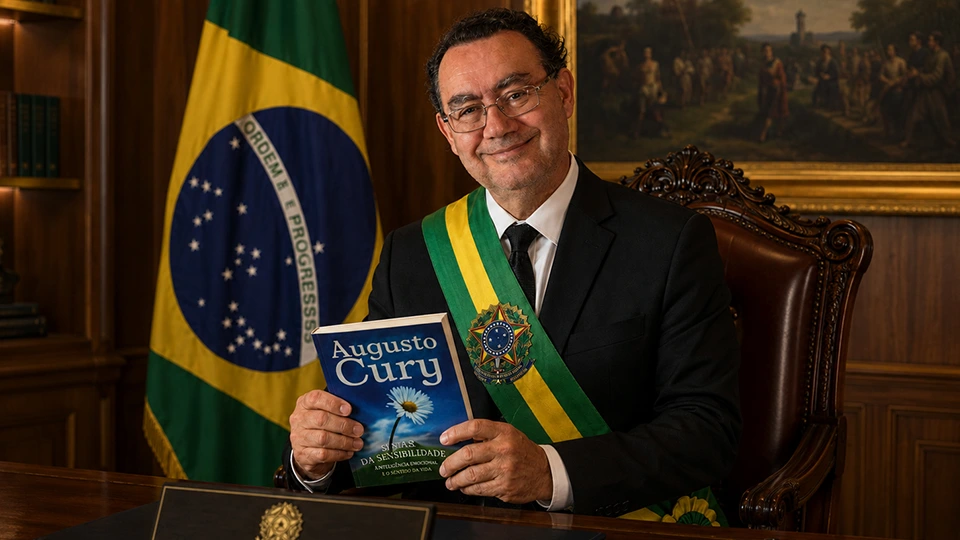
For decades, Augusto Cury was known primarily as a writer, psychiatrist, and popular communicator on anxiety, emotional education, and the workings of the mind. His books reached millions of readers, some were adapted for film and theater, and his name became familiar in schools, companies, clinical settings, and human-development events. In 2026, however, he took on a very different role: he became the Avante party’s candidate for president of Brazil.
The shift raised a legitimate question. What can an author who specializes in human behavior offer the administration of a country as complex as Brazil? The answer should begin with neither automatic admiration nor premature rejection. Writing popular books, developing psychological concepts, and speaking to large audiences are relevant experiences, but governing requires additional abilities: assembling expert teams, negotiating with Congress, managing a budget, setting priorities, and turning intentions into verifiable public policies.
Understanding his candidacy requires separating three dimensions. The first is Augusto Cury’s personal and intellectual career. The second is the set of ideas found in his books. The third is his political platform, which must be assessed by the same standards applied to any candidate: clarity, feasibility, cost, institutional support, and capacity for execution.
This article explains who Augusto Cury is, introduces some of his best-known books, examines how his ideas relate to his candidacy, and identifies the areas in which he says he could contribute to Brazil. It also considers the limits of moving from psychology into politics, because a serious analysis must weigh both potential and risk.
What You Will Find in This Article
- Who Is Augusto Cury?
- The Books That Made Augusto Cury Famous
- From Books and Clinical Work to Politics
- What Augusto Cury Proposes for Brazil
- What His Experience Could Add to the Presidency
- Popularity Is Not the Same as Preparation
- How to Assess the Candidacy Rationally
- The Possible Legacy of His Candidacy
🎧 Audio version of this article
Who Is Augusto Cury?
Augusto Jorge Cury was born in Colina, in the state of São Paulo, in 1958. He studied medicine and built his public identity as a psychiatrist, professor, researcher, and writer. His work focuses on anxiety, the formation of thought, family relationships, leadership, education, the prevention of emotional disorders, and the development of psychological autonomy.
The central framework of his work is what he calls Multifocal Intelligence Theory. Broadly speaking, Cury attempts to explain how thoughts and emotions are formed and how individuals can take a more conscious stance toward their own mental activity. His books usually combine psychological concepts, practical guidance, observations about behavior, and, in some cases, fictional storytelling.
His commercial reach is among the most visible aspects of his career. Cury’s official website reports tens of millions of copies sold and distribution in more than 70 countries. Those figures are presented by his own organization and help illustrate his popularity, but they do not replace independent scientific assessment of his theories. Commercial reach and academic validation are different standards.
That distinction matters because public debate often blends authority, fame, and competence. A person may communicate psychological subjects effectively while some of their formulations remain disputed by researchers. Likewise, a theory may be useful as a framework for personal reflection without having the same status as a widely tested clinical protocol. A productive way to assess Cury is to examine what his ideas propose, where they may be useful, and which claims require additional evidence.
Before entering the presidential race, his work had already expanded beyond books. Social-emotional education projects, emotion-management courses, lectures, and initiatives for families, educators, and organizations broadened his activities. That background helps explain why education and emotional health play such a prominent role in his political message.
The Books That Made Augusto Cury Famous
Augusto Cury has published extensively across essays, practical psychology, education, and fiction. Rather than treating every title as equivalent, it is useful to look at several works that represent the recurring themes in his writing.
The Dreamseller
The Dreamseller is one of Cury’s best-known works. The novel follows a character who intervenes in moments of suffering and invites others to reconsider the meaning they give to life, success, and human relationships. Its story addresses despair, dignity, empathy, criticism of consumerism, and the reconstruction of purpose.
The book produced sequels and a film adaptation. Its significance in Cury’s career lies in its ability to translate existential questions into an accessible narrative. Instead of presenting concepts alone, it organizes psychological conflicts around characters and decisions. That approach brought the author to readers who might not otherwise seek a technical text on mental health.
Anxiety: How to Face the Evil of the Century
In this book, Cury discusses racing thoughts, overstimulation, anticipating problems, and the difficulty of resting mentally. The subject resonated widely because anxiety, pressure to perform, and information overload are part of everyday life for millions of people.
The book’s practical contribution is to draw attention to mental habits that intensify distress: rumination, the need for control, excessive self-demand, and constant exposure to information. At the same time, anxiety should not be treated as a problem that reading or personal discipline can always solve. Anxiety disorders may require assessment and treatment by qualified professionals.
Brilliant Parents, Fascinating Teachers
In this work, Cury discusses the emotional development of children and adolescents and distinguishes the transmission of information from the formation of independent thinkers. He argues that parents and teachers should not merely demand performance or impose rules. They should help young people understand emotions, tolerate frustration, develop empathy, and think before reacting.
The message addresses a genuine educational problem: a school may deliver academic content without teaching students how to handle conflict, pressure, fear of failure, and coexistence. The proposal’s merit lies in broadening the idea of education. Its challenge is turning broad principles into practices that respect teacher training, educational evidence, regional diversity, and the actual conditions in schools.
The Code of Intelligence
The Code of Intelligence presents skills that Cury associates with mental autonomy, including self-criticism, resilience, thought management, and the ability to see another person’s point of view. The work challenges the idea that intelligence is limited to memory, logical reasoning, or academic performance.
That argument has political implications. A democratic society depends on citizens who can assess information, tolerate disagreement, and correct their own positions. Yet those abilities cannot be created by decree. They require strong education, reasonably secure family environments, access to culture, and institutions that do not continually reward misinformation and aggression.
Emotion Management
In his work on emotion management, Cury insists that individuals cannot control everything they feel or think, but they can develop greater awareness of their responses. The goal is not to eliminate negative emotions but to prevent impulses from automatically determining decisions and relationships.
Applied to public life, that principle points toward politics less governed by resentment, fear, and the worship or demonization of political figures. But defending emotional balance is not the same as resolving social conflict. Polarization does not arise only from individual temperament; it is also fueled by inequality, competition for resources, party strategies, social-media incentives, and genuine conflicts of interest.
From Books and Clinical Work to Politics
Augusto Cury entered national politics without an electoral career comparable to those of traditional candidates. He announced his intention to run for president, joined Avante, and had his candidacy formally confirmed by the party in 2026. His running mate is Júlio Delgado, a former federal representative who served five terms and adds legislative experience to the ticket.
According to the Veja article used as the original reference, the candidacy rests on a structure that is less improvised than Cury’s outsider image might suggest. Avante has access to party funding and broadcast time, while the campaign team includes professionals with experience in national races. The report also describes the party as pragmatic, with a history of supporting candidates from different political camps.
Cury presents himself as an alternative to polarization. That position may appeal to voters tired of hostility between groups and of reducing the national debate to partisan identities. Psychologically, a promise of reconciliation is powerful because it offers a way out of seemingly permanent conflict.
Yet rejecting the labels of left and right does not eliminate ideological choices. Every government must decide how to tax and spend, what role the state should play, how markets should be regulated, which reforms deserve priority, and how costs should be distributed. Even a candidacy that claims to rise above polarization must make decisions that benefit some interests, limit others, and generate opposition.
The relevant test, therefore, is not whether Cury talks about peace. It is how that peace would be pursued without neutralizing legitimate disagreement, concealing distributional conflicts, or reducing political opposition to a lack of emotional balance.
What Augusto Cury Proposes for Brazil
The platform associated with Cury’s candidacy places strong emphasis on emotional health, education, neuroinclusion, entrepreneurship, and institutional reform. The following sections examine its main areas as declared proposals, not guaranteed outcomes.
Mental Health and Prevention
The issue most consistent with Cury’s career is mental health. His message begins with the diagnosis that Brazilians are under heavy emotional strain and that public authorities often act too late, after distress has already become a crisis, absence from work, withdrawal from school, or a need for specialized treatment.
A preventive agenda could produce real gains. Early-identification programs, training for primary-care professionals, guidance for families, anti-stigma campaigns, and coordination between health and education services could reduce suffering and facilitate access to care. It is also reasonable to argue that mental-health policy should not be limited to hospitalization or extreme situations.
Prevention, however, cannot be confused with slogans about positive thinking. A national policy must be integrated with Brazil’s Unified Health System, Psychosocial Care Centers, primary care, emergency services, and social-protection networks. It must also define its target population, methods, training requirements, indicators, cost, and referral mechanisms.
Cury’s greatest potential in this field is his ability to place mental health at the center of presidential debate. The main risk is making policy too dependent on his own methods, without sufficient comparison with evidence-based programs or broad participation by independent experts.
Emotional Education in Schools
Another recurring theme is the inclusion of emotional skills in schools. The proposal begins from a valid observation: students learn under concrete emotional and social conditions. Anxiety, violence, humiliation, food insecurity, family conflict, and fear of failure all affect learning.
A well-designed policy could train teachers to recognize signs of distress, strengthen coexistence, prevent violence, teach conflict resolution, and create channels for support. It could also encourage critical thinking, listening, and tolerance for frustration without turning the classroom into a therapy office.
Care must be taken not to overload teachers who already face large classes, low pay, and inadequate infrastructure. Emotional education requires suitable materials, multidisciplinary teams, assessment, and respect for the boundaries of the teaching role. Teachers should not be made responsible for diagnosing or treating disorders.
If Cury could turn his communication experience into a policy built with educators, psychologists, researchers, and public administrators, he could help expand a neglected dimension of schooling. If the proposal were implemented as a closed package tied to a single theory, it would have less legitimacy and reach.
Neuroinclusion
The candidacy also highlights policies for neurodivergent people, including those with autism, ADHD, dyslexia, learning disorders, and giftedness. This field involves challenges across health care, education, social assistance, employment, and human rights.
A national strategy could improve assessment, reduce waiting lists, support families, prepare schools, and create conditions for workplace inclusion. It would also need to avoid two extremes: excluding people who need support and trivializing diagnoses without proper assessment.
Good intentions in this area must be supported by technical criteria and direct participation from the people affected. No neuroinclusion project should be designed only by specialists, relatives, or public officials. Neurodivergent people must have a voice in policies that shape their lives.
Fighting Violence Against Women and Protecting Children
The platform publicized by the campaign includes initiatives to protect women and to ensure that children and adolescents are heard. The concern is important, but effectiveness will depend on integration with existing structures: social-assistance networks, police units, the courts, schools, child-protection councils, and health services.
Technology can help activate services, map risk, and monitor protective orders. It cannot replace professionals, shelters, investigation, rapid response, or economic protection. A victim may know how to report abuse and still remain vulnerable if local services are absent or if she lacks the material means to leave an aggressor.
To deliver results, any proposal must answer objective questions: who receives an alert, how quickly, with what staff, under which protocol, and with what data protections? Without that architecture, innovation risks becoming merely a campaign image.
Entrepreneurship and a Distributed Economy
Cury also connects human development with entrepreneurship. Expanding opportunities beyond Brazil’s largest urban centers could be positive, especially in areas with little formal employment and limited economic diversity.
Encouraging entrepreneurship, however, requires more than motivation and courses. Small businesses depend on credit, infrastructure, legal certainty, access to markets, technology, logistics, and demand. Many Brazilians start businesses out of necessity and remain in precarious conditions. A responsible policy must distinguish productive entrepreneurship from transferring economic risk to individuals.
Cury’s background in education and leadership may contribute to training initiatives. Nevertheless, macroeconomic decisions require teams with expertise in budgets, taxation, productivity, international trade, industrial policy, and regional inequality. At that point, the composition of a possible administration matters more than the president’s personal specialty.
Political Reform and Semi-Presidentialism
The institutional proposals include a debate over semi-presidentialism. Under that model, the president shares governing duties with a prime minister supported by Parliament. Advocates say it can reduce conflict between the executive and legislature; critics fear blurred accountability, greater power for party leadership, and a poor fit with Brazil’s political system.
A change of that scale cannot be made by presidential will alone. It requires constitutional debate, legislative support, and a detailed definition of responsibilities. Nor would it automatically solve party fragmentation, low institutional trust, or transactional politics.
Raising the reform has merit because it stimulates discussion about governability. The danger lies in presenting institutional change as a simple answer to problems with multiple causes. Political systems operate through formal rules, institutional culture, the quality of parties, and the behavior of political actors.
What His Experience Could Add to the Presidency
Augusto Cury has several characteristics that could be useful in public life. The first is communication. He built a career explaining abstract ideas to broad audiences, a valuable skill for a president who must present priorities, reduce confusion, and speak with different groups.
The second is familiarity with human issues often treated as secondary. Mental health, prevention, family relationships, and emotional education affect productivity, violence, learning, and quality of life. Placing them at the center of public planning could address a historic blind spot.
The third is his attempt to reach voters outside the most rigid political identities. In an environment dominated by antagonism, a candidacy oriented toward dialogue may create space for issues less dependent on culture-war conflict.
Those qualities are not enough, however. The presidency is not an extension of a lecture hall, a clinic, or a publishing company. The office requires decisions on defense, energy, infrastructure, federal relations, the budget, foreign policy, public safety, regulation, pensions, and crisis response. No candidate personally masters every field, but each must demonstrate sound criteria for choosing teams, resolving disputes, and monitoring outcomes.
Negotiation presents another challenge. Cury may defend reconciliation, but governing requires building a majority in a fragmented Congress without abandoning principles or turning coalition-building into uncontrolled distribution of power. His association with Avante provides political structure, but it also ties him to the party’s history, leaders, and strategies. An experienced campaign team reduces electoral improvisation, but it does not guarantee administrative quality.
The best way to assess what Cury could do for Brazil is therefore to reject the messianic question—“Will he save the country?”—and ask institutional questions instead. Which goals are measurable? How much will they cost? Who will implement them? Which existing programs will be expanded, changed, or ended? How will they be evaluated? What is the strategy for gaining support in Congress? Which legal and budgetary constraints have been considered?
Popularity Is Not the Same as Preparation
Augusto Cury’s publishing success demonstrates an ability to reach people and interpret widely shared concerns. That helps explain interest in his candidacy. Many voters see him as a figure outside traditional politics, with a message focused on emotional health and less closely associated with partisan confrontation.
The outsider image should nevertheless be examined carefully. No presidential campaign is truly independent of political structures. Running requires a party, funding, legal teams, communications operations, alliances, and regional presence. The Veja report shows precisely that a professional and party apparatus stands behind his unconventional profile.
That is not necessarily negative. National campaigns require organization. The question is which commitments the structure creates, who participates in decisions, and how transparency will be preserved. Voters should assess not only the visible candidate, but also the party, the running mate, donors, coordinators, and groups that may hold office in a future administration.
It is also important to distinguish knowledge of human behavior from the ability to solve economic and institutional problems. A president may use principles of dialogue and self-regulation to improve decision-making, but will still need to choose among technical alternatives with different costs and effects. Emotion management may improve the manner of governing; it does not replace economic policy, administrative design, or impact assessment.
How to Assess the Candidacy Rationally
Voters interested in Augusto Cury can begin with the government program itself rather than relying only on interviews, short videos, or campaign phrases. They should look for goals, deadlines, funding sources, responsible agencies, and indicators.
It is also worth comparing his current message with his record. Have his earlier projects produced measurable outcomes? Were they assessed by independent institutions? Can the initiatives be adapted to a national scale? Are there conflicts of interest involving proposed policies, methods, companies, or brands?
The team is another criterion. Who are the experts responsible for the economy, public safety, health care, education, the environment, and foreign affairs? What experience do they have? A campaign centered too heavily on one personality tends to conceal the complexity of government.
Voters should also observe how Cury responds to criticism. Psychological knowledge is not demonstrated by calmness in controlled situations, but by the ability to hear objections, admit limitations, correct information, and live with scrutiny. A president will be challenged by the press, opponents, the courts, Congress, and civil society.
Finally, the party must be examined. Joining Avante is not a bureaucratic detail. Parties select candidates, receive public resources, organize legislative caucuses, and participate in governance. Understanding the party’s history and representatives helps reveal the actual coalition behind Cury’s name.
The Possible Legacy of His Candidacy
Regardless of the election result, Augusto Cury’s presence may have one significant effect: forcing the presidential race to give greater visibility to mental health, emotional distress, social-emotional education, and neuroinclusion. Campaigns can shape the public agenda when they introduce issues that other candidates are then compelled to address.
That legacy will depend on the quality of the debate. If mental health is used only as a personal brand, the issue may be oversimplified. If it is accompanied by data, engagement with the public health system, respect for science, public participation, and executable proposals, the candidacy could improve the discussion.
The same applies to political reconciliation. Brazil needs to reduce the dehumanization of opponents and recover the capacity for cooperation. Yet democratic peace does not mean the absence of opposition, submission, or artificial agreement. It means competing over projects within the rules, recognizing the legitimacy of others, and preserving institutions even after defeat.
Conclusion
Augusto Cury enters politics with an unusual background for a presidential candidate. He is a widely read writer, psychiatrist, communicator, and creator of projects focused on emotion management and education. Books such as The Dreamseller, Anxiety: How to Face the Evil of the Century, Brilliant Parents, Fascinating Teachers, The Code of Intelligence, and Emotion Management help explain the themes that shape his public outlook.
His greatest potential contribution is to expand the attention given to mental health, prevention, emotional education, and neuroinclusion. He may also offer less aggressive language in a polarized environment. Those qualities, however, will translate into governing ability only if they are supported by qualified teams, evidence-based proposals, fiscal responsibility, transparency, democratic negotiation, and constant evaluation.
Voters do not have to choose between idealization and contempt. They can recognize the importance of the issues Cury raises while demanding technical answers. They can value his communication skills without confusing them with mastery of every area of government. They can welcome his defense of dialogue while still examining the party and structure behind his campaign.
What Augusto Cury could do for Brazil depends on more than the ideas in his books. It depends on his ability to move from inspiring messages into the difficult terrain of public execution. That point—where intention, method, and results meet—is where his candidacy should be judged.
Recommended readings
- How to Control Anxiety: A Practical Guide to Regaining Calm
- Mental Rumination: How to Stop Overthinking
- 20 Rules to Raise Emotionally Strong Children and Students
- The Power of Not Reacting: The Science of Walking Away
Sources
- Who Is Behind Augusto Cury's Presidential Candidacy? — Veja
- Augusto Cury — official website
- Avante Confirms Augusto Cury as Its Presidential Candidate — Agência Brasil
- 2026 Elections: Augusto Cury's Profile and Proposals — Band
- Augusto Cury's Government Program Submitted to Brazil's Electoral Court — public copy hosted by Polyapoio