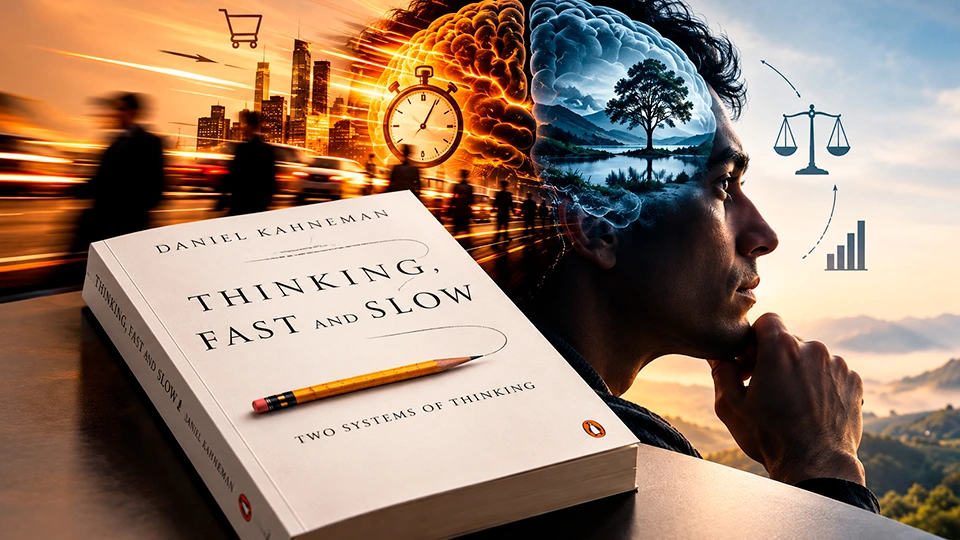
A person can be intelligent, well informed, and sincere, yet reach the wrong conclusion with enormous confidence. They may judge someone on a first impression, agree to an unrealistic deadline, or stick with a poor choice because they have already devoted too much time to it. These mistakes do not always stem from a lack of knowledge. Often, they have to do with how thinking itself works.
In Thinking, Fast and Slow, Daniel Kahneman examines the mechanisms involved in our judgments and decisions. Much of this work grew out of his collaboration with Amos Tversky. The book shows how intuitive responses, automatic associations, and deliberate assessments work together, providing speed in some situations and producing distortions in others.
The book does not offer a formula for always being right. Its value lies in making certain mistakes recognizable—mistakes we would normally mistake for common sense. When we understand how an impression takes on the appearance of certainty, we can examine more carefully the criteria we use to make choices, interpret events, and assess other people.
The lessons below cover the book’s main themes and their everyday applications. The examples help explain the concepts without turning behavioral tendencies into rules that describe everyone in every situation.
What You Will Find in This Article
- The two ways of thinking work together
- An easy answer can replace the right question
- First impressions can influence unrelated judgments
- The first reference point influences judgment
- What we remember easily seems more common
- A convincing story is not a complete explanation
- Intuition needs the right conditions to be reliable
- Planning requires looking at comparable cases
- Gains and losses depend on a reference point
- Past investments can trap future decisions
- The way a choice is presented changes how we see it
- Experiencing something and remembering it are different
- How to apply these lessons to everyday decisions
🎧 Audio version of this article
The two ways of thinking work together
Kahneman uses the labels System 1 and System 2 to describe two modes of mental activity. System 1 refers to fast, automatic operations that require little conscious effort. System 2 is associated with activities that depend on attention, following a sequence of steps, and deliberate effort.
Recognizing an irritated expression or understanding a simple sentence usually happens without a conscious decision to analyze every detail. Comparing offers with different conditions, reviewing an argument, or solving a difficult calculation requires a different kind of involvement. We need to hold information in mind and follow the reasoning.
These systems are explanatory devices. They should not be understood as two people inside the head or as two separate brain regions. Nor do they represent a rigid division between emotion and reason. A calculation practiced many times can become automatic, while lengthy reflection can still be influenced by personal preferences.
Fast thinking is essential. If we had to consciously examine every word, gesture, or object, even the simplest tasks would become unmanageable. Problems arise when an answer that comes easily is accepted in a situation that calls for further checking.
Imagine receiving a job offer presented with great enthusiasm. The recruiter’s warmth and the company’s prestige may create an immediately favorable impression. But assessing the offer requires considering working hours, responsibilities, commuting, and the actual conditions. Enthusiasm provides an initial reaction; it does not replace comparison.
The first lesson, then, is to recognize when a situation deserves additional attention. Decisions that are unfamiliar, difficult to reverse, or consequential warrant closer examination. Even so, spending more time thinking helps only when that time is used to seek relevant information, check assumptions, and compare alternatives.
An easy answer can replace the right question
One of the book’s most useful ideas is question substitution. Faced with a difficult question, the mind may answer a simpler one without noticing the switch. The answer seems appropriate because it arrives quickly and creates a sense of understanding.
Consider hiring a candidate. The relevant question is: can this person do the job well? Answering it requires criteria, evidence, and comparison. A much easier question is: did I enjoy talking to this person? When the second answer replaces the first, personal rapport can be mistaken for competence.
The same thing can happen when assessing an idea. Instead of examining whether the argument holds up, we assess whether the person presenting it sounds confident. Instead of asking whether a change meets our needs, we notice only how exciting it feels at that moment.
This does not mean that warmth, confidence, or enthusiasm are irrelevant. They can provide useful information. The distortion occurs when they become the sole answer to a question that involves other factors. A good conversation may suggest strong communication skills, but it does not establish every ability required for a role.
One practical approach is to write down the question before making an important decision. Then list the information needed to answer it. If the goal is to choose a suitable course, for example, the criteria might include content, prerequisites, available study time, and the quality of the exercises. The impression created by the marketing takes on a more limited role.
This small distinction helps us recognize when we are merely justifying a preference. The question is no longer whether an option looks appealing, but whether the available reasons address the problem we actually need to solve.
First impressions can influence unrelated judgments
The halo effect describes how an initial assessment influences other judgments about the same person or situation. A positive characteristic can encourage positive conclusions about aspects we have not yet examined. A negative characteristic can also influence the rest of the assessment.
An articulate person may seem more competent in subjects they have never shown they understand. A colleague who makes an embarrassing mistake may come to be seen as careless in everything, even with a consistent track record. The mind tends to produce a coherent picture, smoothing over differences that deserve to be preserved.
This coherence makes understanding easier, but it comes at a cost. People can have strengths and limitations at the same time. Someone may explain things very well yet execute them poorly. They may be reserved and work with great precision. They may have failed at one task and handled others competently.
In everyday life, the halo effect encourages broad assessments based on narrow episodes. A person is no longer someone who made a mistake; they are treated as a mistake themselves. Or success in one area earns them credibility on any subject.
One way to limit this influence is to assess separate dimensions before forming an overall impression. In a performance review, for example, work quality, meeting deadlines, and communication can each be examined using their own evidence. A rating in one area does not have to determine the ratings in all the others.
It also helps to ask where each conclusion came from. What was directly observed? What was inferred? Are there enough examples? This distinction does not require approaching every relationship with suspicion. It simply requires care so that a first impression does not become a definitive judgment about everything someone can do.
The first reference point influences judgment
The anchoring effect occurs when an initial value influences a later estimate. Even a reference point that provides little useful information can shape judgment. A person tries to move away from that starting point, but the adjustment may not go far enough.
In the book, Kahneman describes an experiment in which participants saw a number produced by a wheel before estimating the proportion of African countries among UN members. Although the number provided no information about the subject, estimates varied with the reference point presented.
The lesson is that knowing a number should not influence an answer is not always enough to neutralize its effect. The anchor helps shape the estimate even when it does not function as a conscious argument.
Imagine someone suggests that a task will take two hours. The team begins discussing whether it will take three or four without first examining the necessary steps. The entire discussion may remain close to a forecast that never had any basis. If the task requires two days, the problem began before the deadline was negotiated.
Reference points are not necessarily bad. A reliable track record can provide an appropriate starting point. The important question is where the number came from and why it deserves to guide the decision. A deadline measured against similar work has a different value from an improvised estimate.
One practical step is to develop an independent assessment before hearing someone else’s proposal, whenever possible. In a team, each member can record an estimate before the meeting. Differences then reveal assumptions, difficulties, and information that might disappear if everyone started from the first number announced.
What we remember easily seems more common
The availability heuristic involves using the ease of remembering or imagining events to judge their frequency. A recent, striking, or widely discussed event may seem more common than it really is. Memory supplies accessible examples, but not necessarily representative ones.
After witnessing two service failures, someone may conclude that a company never works well. Perhaps there is a recurring problem. Perhaps those episodes were exceptions. The strength of the memory alone does not distinguish between these possibilities.
This mechanism can also affect how we see the division of labor. Each person follows their own effort in greater detail than other people’s. They remember the interruptions, difficulties, and time spent. Some of other people’s work happens out of sight. As a result, several people may sincerely believe that they do most of a shared task.
The book shows that this kind of disagreement need not result from dishonesty. It may reflect differences in access to the memories used to assess each person’s contribution. This does not rule out real inequalities, but it keeps us from assuming that every differing perception is an attempt at manipulation.
To assess frequency, it helps to look for a broader set of records. How often did the problem occur? Out of how many opportunities? Over what period? Does it still seem frequent when we include the ordinary situations that did not attract attention?
At work or at home, recording responsibilities and completed tasks can be more informative than arguing about who feels more overburdened. Those feelings deserve to be heard, but the actual distribution of tasks provides another source of information. Personal recollection becomes part of the analysis rather than its sole foundation.
A convincing story is not a complete explanation
The mind looks for connections between events and organizes them into stories. This helps us understand the world, but it also encourages explanations that are too simple. Once we know an outcome, it becomes easier to see earlier events as steps toward a predictable conclusion.
A company grew, so its strategy seems inevitably brilliant. A project failed, so the warning signs seem to have been obvious from the beginning. Knowing the outcome reshapes our reading of the past. Doubts that existed beforehand lose their place in the later narrative.
Kahneman examines this problem in his discussion of the illusion of understanding and hindsight bias. Explaining what happened after learning the outcome is different from being able to predict it. A narrative may connect real facts while still leaving out alternatives, chance events, and conditions that could have produced a different result.
For this reason, decision quality and outcome quality need to be assessed separately. A careful choice can end badly because of unpredictable factors. A reckless choice can work out through luck. If we learn only from outcomes, we risk repeating poor practices that happened to be rewarded temporarily.
One useful application is to keep a simple record of important decisions. Before acting, write down what you know, what you expect, which uncertainties you recognize, and why you chose a particular course. Once the outcome arrives, you can compare the forecast with the facts without relying entirely on reconstructed memory.
This record also makes it easier to assess your own learning. Instead of saying you always knew something would happen, you can identify what you actually anticipated, what you missed, and which information was unavailable. The analysis becomes more precise and less dependent on the need to appear consistent.
Intuition needs the right conditions to be reliable
The book does not advocate rejecting all intuition. Kahneman distinguishes intuitive responses grounded in relevant experience from impressions that seem competent without having been adequately tested. A subjective feeling of certainty cannot, by itself, tell these situations apart.
In discussing the topic with researcher Gary Klein, he highlights important conditions for developing intuitive skill: an environment with sufficiently predictable regularities and opportunities to learn those regularities through practice. The quality of feedback on successes and mistakes contributes to this learning.
An experienced chess player recognizes configurations that a beginner must examine piece by piece. That speed does not mean a lack of knowledge. It may represent accumulated knowledge that has become automatically accessible. There are recurring patterns and opportunities to check the consequences of choices.
But repeating an activity for years does not, by itself, guarantee reliable intuition. If results are ambiguous, take a long time to emerge, or depend on factors that are difficult to separate, a person may have few opportunities to discover where they went wrong. Experience and learning are not exact synonyms.
It is also important to respect the limits of each field. Being excellent at one activity does not make someone equally competent at predicting events in others. Prestige can easily cross that boundary; skill does not necessarily follow.
Before trusting an impression, it is worth asking whether the situation resembles those in which there has been real practice and consistent feedback. Is the pattern familiar? Have previous mistakes been identified? Has the environment changed? These questions provide better criteria than simply feeling confident. In unfamiliar settings, intuition can serve as an initial hypothesis to examine without automatically being granted the status of a conclusion.
Planning requires looking at comparable cases
When planning, we commonly picture an orderly sequence of events: starting the task, carrying out the steps, and finishing on time. This scenario describes how we would like the work to unfold. It does not always include the interruptions, rework, dependencies, and difficulties that tend to arise in real projects.
Kahneman discusses this problem through the planning fallacy and the distinction between the inside view and the outside view. The inside view focuses on a project’s particular features and its participants’ intentions. The outside view considers what happened across a class of comparable cases.
A person may calculate that they will finish a course in three months by dividing the number of lessons by the available days. But if they frequently had to interrupt their studies on previous attempts, that history also needs to enter the forecast. An ideal schedule does not erase the actual conditions of daily life.
Looking at similar cases helps establish a reference point that depends less on initial enthusiasm. How long do activities of this kind usually take? Which obstacles recur? How many attempts were completed? The comparison should include ordinary outcomes and difficulties, not just stories of exceptional performance.
This does not mean treating every past experience as destiny. A project may have better resources or different conditions. Those differences, however, need to be demonstrated. The conviction that this time will be different is a hypothesis that requires justification.
In practice, more careful planning combines earlier data with current circumstances. It also makes dependencies explicit: what requires someone else’s response, which stage may need correction, and where uncertainty is greatest. Rather than promising a precise deadline based on a perfect scenario, it makes the conditions necessary for that deadline visible.
Gains and losses depend on a reference point
The same situation can be perceived as progress or a setback depending on the point of comparison. This is one of the central elements of prospect theory as presented in the book: we assess outcomes relative to a reference point, not simply by considering the final state in isolation.
Imagine two people who receive the same performance rating. One expected a lower result and feels satisfied. The other was expecting a much higher rating and feels frustrated. The outcome is the same, but the perceived change relative to expectations differs.
Loss aversion adds another dimension. In many of the situations described in the book, losing something carries more weight than gaining an equivalent amount. This pattern helps explain resistance to leaving a familiar situation, even when an alternative deserves consideration.
It is important to avoid a mechanical interpretation. The concept does not mean that every loss has a fixed weight for everyone. Nor does it justify classifying all caution as irrational. Some losses have serious practical consequences, and recognizing those consequences is part of an appropriate assessment.
The reference point itself, however, may go unnoticed. A person may assess their performance only against the best result they have ever achieved, ignoring the conditions at that time. Everything that follows seems inadequate. Someone else may reject a change because they compare its real costs with an idealized version of their current situation.
A useful question is: compared with what does this feel like a loss? What exists today, what was promised, the best moment in the past, or what I imagined receiving? Identifying that reference point helps separate real consequences from expectations that have come to function as guarantees.
Past investments can trap future decisions
Kahneman also discusses how earlier expenses and efforts influence later choices. The problem of sunk costs arises when what has already been spent becomes a reason to spend more, even though it does not improve the prospects of the current decision.
A person may continue a course that no longer meets their goal because they have already attended most of the classes. A team may keep an unhelpful project going because they have worked on it for months. Continuing starts to serve an attempt to prove that the earlier effort was worthwhile.
The past matters as a source of learning and as the origin of resources that may still be useful. The mistake is treating a cost that cannot be recovered as though persistence could bring it back. Time already spent does not return when we devote more time to an unsuitable activity.
One way to examine the situation is to ask: if I were deciding today, knowing the current conditions, would I choose to continue? This question shifts the focus to future benefits and costs. It does not determine the answer, but it helps reveal which part of the justification depends solely on the earlier investment.
There are situations in which continuing makes sense. The work already done may have produced useful knowledge, only a few steps may remain, or stopping may carry real costs. These factors differ from persisting simply to avoid admitting a mistake. They need to be assessed by their consequences from this point onward.
This lesson also calls for review criteria. Before starting a lengthy activity, it can help to define the conditions under which the plan will be reassessed. That way, review does not have to depend entirely on how a person feels after becoming involved. Changing direction becomes part of the decision process rather than automatically representing failure.
The way a choice is presented changes how we see it
Framing is the way a situation is presented. Equivalent information can produce different assessments when it emphasizes gains, losses, success, or failure. Our response depends not only on the data but also on which aspect receives the most attention.
Imagine a process that completes ninety out of every hundred tasks without rework. Saying that it has a ninety percent success rate may create a different impression from saying that ten percent of tasks require correction. If the definition of success is the same, the numbers describe the same outcome.
Even so, each formulation directs attention to a different part of the picture. The first draws attention to satisfactory performance. The second highlights problems. Neither, by itself, tells us the cost of rework, the significance of failures, or how alternatives perform.
Framing also appears in how goals are formulated. Preserving what already exists and seeking an improvement may describe aspects of the same choice while bringing different concerns to the fore. When a conversation remains stuck in a single formulation, some consequences go unexamined.
One practical approach is to rewrite the choice in equivalent ways and see whether your preference changes. What does the option allow you to gain? What does it require you to give up? What is the outcome in absolute numbers? Are the options being compared over the same period and against the same criteria?
This exercise does not eliminate emotions or require a purely mathematical decision. It helps prevent language alone from determining which factors get considered. When the framing changes and your preference shifts, it is worth investigating why before concluding that one option is obviously superior.
Experiencing something and remembering it are different
In the final part of the book, Kahneman distinguishes the experiencing self from the remembering self. The first concerns experience as it happens. The second constructs a retrospective assessment. That assessment is not a complete reproduction in which every lived moment receives proportional weight.
In the studies discussed in the book, moments of greatest intensity and the way an experience ends can carry considerable weight in memory. Duration may also receive less importance than we would expect. These patterns should not be treated as an infallible rule for every memory, but they help explain differences between experiencing and remembering.
A meeting may have been productive for most of its duration and ended in an unpleasant argument. Afterward, the final conflict may dominate the assessment of the meeting. This does not make the conflict irrelevant. It simply means that it may occupy a greater share of the memory than it did of the entire experience.
The distinction is useful when assessing everyday life. An exceptional moment of recognition may carry great weight in the story we tell about a job, while day-to-day work remains exhausting or unsatisfying. The reverse can also happen: a reasonably good week may be remembered only for its most difficult episode.
To examine your own experience more accurately, it helps to consider records made at different moments rather than relying exclusively on a final assessment. What were the ordinary days like? What kept recurring? How much time did the good and bad situations occupy? What changed after a memorable episode?
The book does not resolve this question by simply choosing one perspective over the other. Everyday experience matters, as does the story we construct about it. The lesson is to recognize possible discrepancies and avoid allowing a single moment to automatically represent an entire period.
How to apply these lessons to everyday decisions
Knowing the name of a bias does not make us immune to it. We can identify anchoring, overconfidence, or the halo effect in others while remaining subject to the same processes. Familiarity with the concepts may even encourage unwarranted confidence in our own judgment.
For this reason, the most useful application of Thinking, Fast and Slow lies in how we organize decisions. Before making an important choice, formulate the question you need to answer, separate facts from impressions, and look for comparable reference points. Record the main uncertainties. Consider what would change your mind, and examine an alternative that is not your preferred option.
In group decisions, collecting individual assessments before discussion can preserve information that might otherwise disappear under the influence of the first opinion. For repeated activities, consistent criteria make it possible to compare results and learn from mistakes. In lengthy projects, scheduled reviews help reveal when conditions have changed.
These precautions should be proportional to the decision. There is no need to turn every everyday choice into an extensive investigation. Attention is limited and needs to be directed toward the points where checking could prevent significant consequences.
Perhaps the book’s most demanding lesson is accepting that a sense of clarity does not end an inquiry. Sometimes it shows only that we have managed to build a comfortable explanation from the available information. The next step may be to look for precisely the information that was left out.
Thinking better involves creating conditions in which we can correct our own judgment. This includes tolerating doubt, listening to a well-founded objection, and revising a choice without trying to protect an image of someone who never makes mistakes. The ability to change course may be more useful than the confidence with which we defend our first answer.
Recommended reading
- Paradox of Choice: Why Too Many Options Paralyze the Mind
- Does the Law of Attraction Work? A Psychological Analysis
- Mental Rumination: How to Stop Overthinking
Sources
- Source: Thinking, Fast and Slow, by Daniel Kahneman. Reference edition: Rápido e Devagar: Duas Formas de Pensar, translated into Portuguese by Cássio de Arantes Leite. Objetiva, 2012.